Waterborne Vision 2040 & 2050
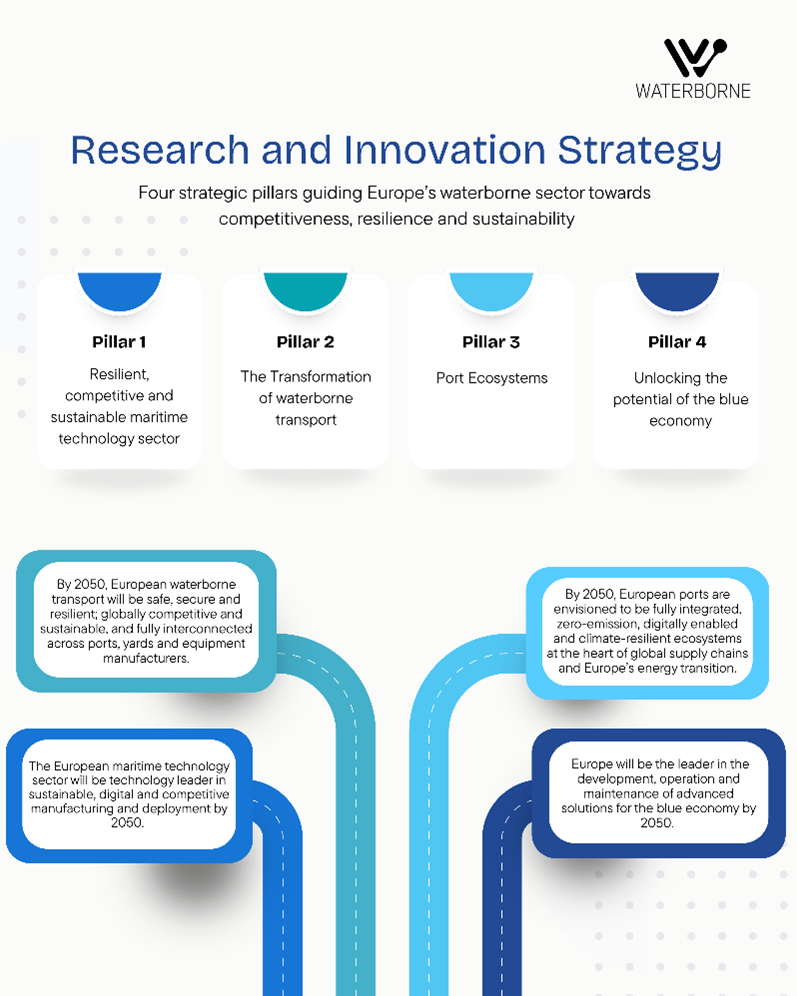
The waterborne sector has developed an ambitious set of missions and visions to be achieved by 2040 and 2050 for the three Thematic Research and Innovation Groups (TRIG’s) Vessel Technologies and Operations, Port Ecosystems and Blue Economy in the Strategic Research Agenda. The document Technology Leadership translates these missions and visions into a detailed Research & Innovation Strategy to be implemented across the European waterborne sector.
European Technology Leadership
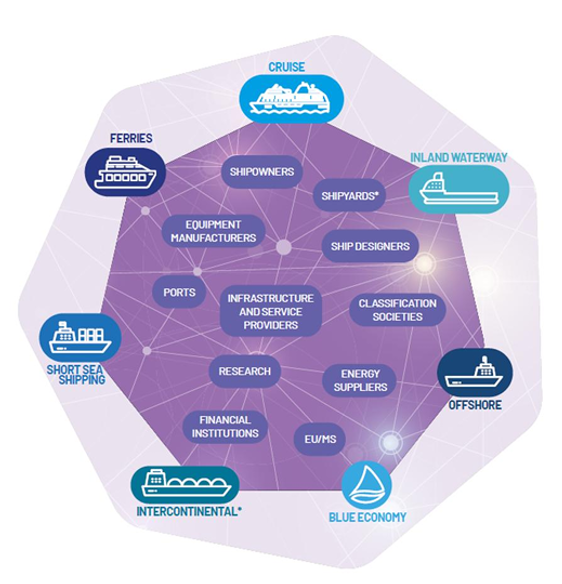
The European waterborne sector is a dynamic and highly interdependent ecosystem, featuring a diverse array of public and private stakeholders, including shipowners (both maritime and inland navigation), shipbuilders, equipment manufacturers, ports, classification societies, energy, infrastructure and service providers, blue economy actors as well as universities and research institutes. The sector plays a significant role in reinforcing the EU’s resilience in terms of trade, safety, security, defence, energy supply and sustainability, while enabling more robust supply chains as well as the transition towards sustainable energy. Furthermore, the waterborne sector is fundamental to Europe’s sovereignty and economic and strategic autonomy and provides the most suitable pathway to achieve the EU’s climate ambitions.
The European maritime technology sector holds a global leading position in high-technology shipbuilding and leads in green and smart port and shipping technologies. European companies supply almost half of the world’s maritime equipment and play a leading role in designing and developing most of the global fleet’s power systems. The solutions developed by the European maritime technology sector are key for dual-use purposes, significantly contributing to EU preparedness, security and overall resilience. The European maritime fleet is among the largest in the world, representing 35% of the global shipping fleet. Furthermore, the European waterborne sector includes approximately 12,000 inland navigation vessels, which are essential for intra-EU trade.
European Ports are gateways for trade, logistics, energy and military mobility, and serve as strategic hubs that enable the energy transition, promote modal shift, and advance the decarbonisation of the waterborne sector.
Beyond transport, the waterborne sector plays a strategic role in blue economy, as it includes the development and production of offshore platform technologies, for example large scale offshore wind parks. It also supports blue economy activities such as fishing and aquaculture and is a technology leader in the underwater domain. Furthermore, it strengthens long-term industrial stability by providing a stained demand for the shipbuilding market.
However, the sector is facing several challenges, that require tailored, coordinated policy and research response. Recent EU initiatives, such as the Industrial Maritime Strategy, the EU Ports Strategy, and the Draghi Report on European competitiveness, underline the urgency of accelerating the twin green and digital transition of the European waterborne sector.
In response, that requires a comprehensive, mission-driven Research and Innovation Strategy. This strategy should enable rapid technological progress, accelerated demonstration and deployment, strengthened industrial competitiveness, and the seamless integration of innovations across vessels, ports, infrastructure and the expanding blue economy. A new co-programmed Partnership under Framework Programme 10 is identified as the key instrument to bridge the innovation-to-deployment gap and to maintain Europe’s Technology Leadership.
Key Challenges
The European waterborne sector differs from other industrial sectors due to its scale, technologies and fuels, long asset timelines, demanding operating environments and complex regulatory frameworks. The Draghi report on EU competitiveness highlights challenges faced by the sector in relation to international competition and geopolitical development. Distortive competition on the global market strongly affects the waterborne sector, including the shipbuilding sector, shipowners and ports. including shipowners and ports. This is further complicated by substantial public investments in research, development and innovation in competing regions.
Additionally, increased labour shortages combined with the growing demand for the waterborne sector present significant challenges for the sector as well. The ageing and declining population in Europe is expected to intensify labour shortages across the sector affecting all segments. At the same time, the world population is projected to reach 9.7 billion by 2050, resulting in increased global trade volumes and waterborne transport demand.
The transition to a zero-emission waterborne sector will require substantial investment with the estimated investment needs for decarbonising international maritime transport alone at EUR 39 Billion each year between 2039 and 2050.
The Sustainable and Smart Mobility Strategy lays down the objective of shifting the share of freight towards rail, inland waterways and shortsea shipping. The milestones of the Modal Shift set envisage an increase of transport by inland waterways and shortsea shipping by 25% by 2030 and 50% by 2050.
The Diversified ecosystem of the waterborne sector comprises a very large number of highly diversified and complex actors, including approximately 300 shipyards and 22.000 equipment manufacturers across Europe, alongside shipping companies and port operators. It is also shaped by international, European, national, and regional regulatory frameworks and involves a high number of authorities, including ports, rivers and waterway administrations, as well as maritime and inland authorities. Fragmented developments are costly and slow; therefore, the twin green and digital transition of the waterborne sector requires a holistic and coordinated approach that brings together public and private stakeholders across the entire value chain.
To meet multiple policy objectives, remain internationally competitive, address demographic challenges, achieve the transition to a zero-emission sector and strengthen Europe’s resilience, an urgency of action is required, including radical changes, rapid development and the deployment of new technologies.
A systemic approach to RD&I, Upscaling and Deployment
Technology Leadership can only be achieved and sustained when RD&I, upscaling and deployment are addressed from an ecosystem perspective and through a close interaction between its different actors. To remain a global frontrunner, Europe depends on the resilience and performance of an interconnected ecosystem. Technology leadership in this context means being a frontrunner in enabling the transformation, by developing and deploying competitive solutions that mitigate climate change, provide the capability to become climate resilient, eliminate all harmful pollutants, improve working conditions or create new jobs, and stimulate economic prosperity, all while ensuring safety and security.
The proposed Partnership will address the full innovation chain, from fundamental research through to deployment. Emphasis will be placed on upscaling solutions and bridging the “valley of death” by supporting technologies in becoming commercially viable and deployable at scale. To stimulate deployment, dedicated technology roadmaps will be developed for different product and system categories.
Stimulating the systematic deployment and accelerating the transition towards a resilient, competitive and sustainable European maritime technology sector, also presents opportunities to export European solutions and products to global markets. A competitive value chain heavily depends on a resilient supply chain, and a reliable delivery requires a well-connected and innovative trans-European network.